+86-13901441113


Choosing an Outdoor Play Slide is not just a matter of picking a bright color or an exciting shape. The right choice depends on the children who will use it, the space available, and how the equipment will be installed and maintained. A slide that looks perfect in a catalog may feel too steep for a young child or too large for a compact yard. Those details matter.
Start with the child’s age, size, and confidence on playground equipment. Check the manufacturer’s guidance for recommended users, dimensions, and installation requirements. Look closely at the ladder, handholds, side rails, and the area where children step off. A stable, level base and clear space around the slide can reduce common risks, but supervision remains important. No product makes play entirely risk-free.
Materials deserve a closer look, too. Plastic can be lightweight and easy to clean, while other designs may use metal or wood and need different care. Consider how the surface may feel in direct sun, whether edges are smooth, and how weather could affect the equipment over time. Small details count. I would not choose by appearance alone; even a sturdy-looking slide can disappoint if it is hard to assemble or awkward to inspect. This guide will help you compare size, materials, safety features, and upkeep, so you can make a practical choice for your family and play area.
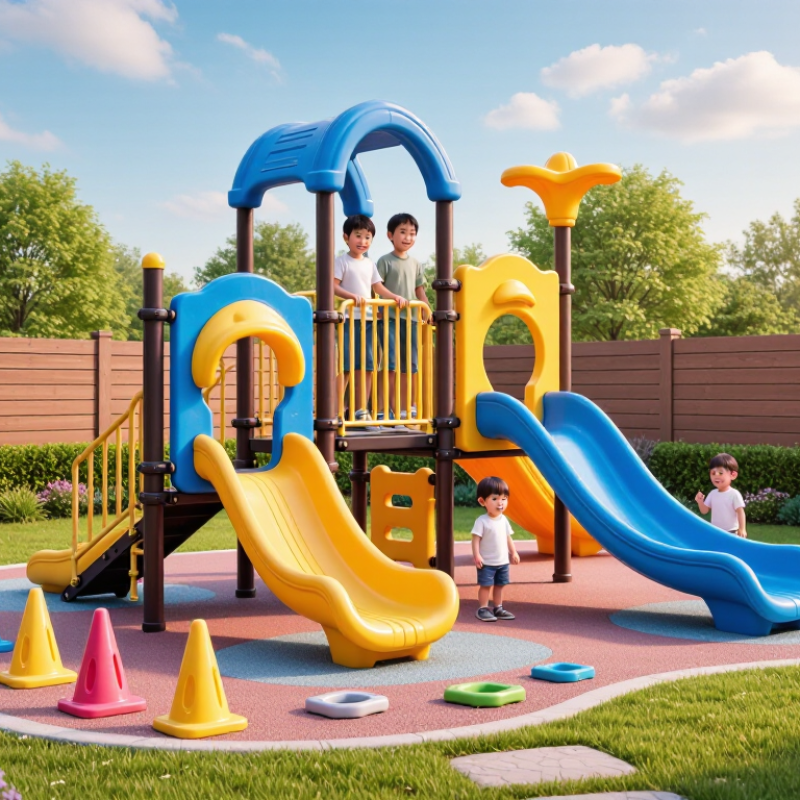
A slide should fit the child, not just the available space.
The U.S. Consumer Product Safety Commission’s Public Playground Safety Handbook (2015) divides play equipment into age groups: 6–23 months, 2–5 years, and 5–12 years. These bands are useful starting points, not a substitute for watching how children actually move. A toddler may need low steps, handholds, and a short, gentle slope; older children may manage a taller slide but still need a clear landing zone.
Small details matter.
Consider abilities as well as age. Can children climb independently, keep their balance, and sit steadily during descent? For children with limited mobility or coordination, look for a route to the platform that does not rely only on narrow stairs, plus enough room for an adult to assist.
The setting matters too: measure the slide’s fall zone, check the surface beneath it, and note nearby paths, fences, and trees. CPSC guidance links surfacing to equipment fall height, so a soft-looking lawn is not automatically protective. On a busy shared yard, visibility and separation from running routes may matter as much as slide height.
It is easy to overvalue a dramatic slide; honestly, a safer, usable one may see more play. Before choosing, compare the actual site and children with the handbook’s age guidance and applicable ASTM playground-equipment standards.
Choosing an outdoor slide starts with the users and the available space. Straight slides suit compact yards and simple access routes. Wave slides add gentle changes in speed and posture, while spiral slides need more room and closer supervision. Enclosed tube slides can feel secure, but adults should be able to see the entry and exit clearly. I would not rely on an age label alone; children’s coordination and the site layout matter too.
Material changes comfort and upkeep. High-density polyethylene is lightweight and resists rust, but inspect it for cracks and fading. Fiberglass can form smooth curves, though damaged edges need prompt attention. Metal is durable, yet direct sun can make a slide surface uncomfortably hot. Check it during the hottest part of the day. Small details matter: secure handholds, smooth seams, a clear exit, and enough space around the slide.
Safety deserves equal weight with shape. The CDC reports that more than 200,000 children aged 14 and younger receive emergency-department care for playground-related injuries each year in the United States. The CPSC’s Public Playground Safety Handbook recommends age-appropriate equipment and protective surfacing in fall zones. Compare each slide’s fall height with the surfacing specification, and check installation depth after settling. That part is easy to overlook. Even good plans can miss a site-specific issue, so inspect the finished area before children use it.
Compare common slide materials using typical material density ranges.
HDPE is lightweight, while stainless steel is much denser; fiberglass-reinforced plastic falls between them. These are typical material values, not specifications for finished slides. Density alone does not determine safety or comfort: also consider slide height, layout, surface temperature, edge finishing, and the applicable playground safety standards.
Reference ranges: HDPE 0.94–0.97 g/cm³; fiberglass-reinforced plastic 1.5–2.0 g/cm³; 304 stainless steel 7.9–8.0 g/cm³. Actual values vary by grade and formulation.
Measure the slide’s vertical height from the platform surface to the protective surfacing below. Check the ground at the landing point, too; loose fill can shift or compact, changing the effective drop. Then measure the chute’s slope with an inclinometer, following the slide surface rather than its support frame. A steep section or abrupt curve can matter as much as the overall angle. There is no single angle that suits every slide. Compare measurements with the equipment instructions and applicable playground guidance. Small details matter.
Plan clearance from the slide exit, not just from the ladder or platform. The U.S. Consumer Product Safety Commission’s Public Playground Safety Handbook (Publication 325, 2015) recommends a slide use zone extending 6 feet beyond the exit for slides 4 feet high or less, and 8 feet for slides higher than 4 feet. Keep that landing area free of edging, tree roots, rocks, and other obstacles. The handbook also describes a general 6-foot use zone around most stationary equipment, though layout exceptions apply. Measure the actual site after installation; drawings can miss a raised border or uneven patch. That part is easy to misjudge.
Check the slide’s age and weight limits, sidewalls, handholds, and platform barriers before buying. These details matter most when a child climbs, turns, or reaches the top. The U.S. Consumer Product Safety Commission’s Public Playground Safety Handbook recommends protective surfacing extending at least six feet around play equipment. A neat lawn is not impact protection. Choose a suitable surface and confirm its required depth and coverage.
Check whether the equipment is designed for home use and aligns with ASTM F1148, the consumer safety specification for home playground equipment. ASTM standards are not a substitute for local requirements or the manufacturer’s instructions. Installation needs a level base, secure anchoring, and clear space at the slide exit. Measure the site before assembly; a slide that fits on paper may still crowd a fence or walkway. The CDC has reported more than 200,000 U.S. children receive emergency care for playground-related injuries annually. That figure covers many kinds of playground equipment, not slides alone.
Tips: Keep the exit zone clear. Tighten fasteners after installation, then inspect them regularly for looseness, rust, or sharp edges. Check for gaps that could trap clothing or fingers. A small detail is easy to miss. Recheck the setup as children grow; I would not assume last year’s fit is still right.
A slide’s upkeep starts with its setting. Before buying, note whether it will sit in full sun, coastal air, or a spot where water collects. Strong sunlight can fade and weaken some plastics; trapped moisture can speed corrosion on metal fittings. Choose materials and finishes rated for local conditions, and check that drainage prevents puddles beneath the slide. Small details matter.
The U.S. Consumer Product Safety Commission’s Public Playground Safety Handbook reports that more than 200,000 children receive emergency-room treatment each year for playground-related injuries. That figure covers many types of playground equipment, but it underlines why regular checks matter. Look for cracks, sharp edges, loose bolts, rust, and worn steps. Follow the maker’s care instructions, tighten fittings as specified, and keep a simple inspection log. It takes minutes.
Durability is not just about a strong-looking surface. A slide exposed to heat and cold needs materials that resist cracking, warping, and fading; metal parts need weather-resistant finishes. Ask how parts can be replaced and whether the slide is designed for your expected use. A quick rinse may remove dirt, but it will not fix sun damage or a loose anchor. I would not assume “low maintenance” means maintenance-free; even sturdy equipment needs a closer look after harsh weather.